Your Google Business Profile Photos May Be Costing You Roofing Jobs
Two roofing companies can serve the same city, offer the same type of work, have similar reviews, and charge roughly similar prices. Yet one can immediately look more trustworthy than the other when a homeowner finds them on Google.
One profile looks like a roofing company that is actively replacing roofs every week. The other looks like somebody downloaded a few roofing images, added a logo, and called it a Google Business Profile.
If you were about to spend $15,000 on a roof, which company would you call first?
That judgment can happen before the homeowner ever reaches your website. They do not know your crews, your installation standards, how carefully you protect the property, or how many roofs you have completed this year. They have to judge your company from the evidence in front of them — and your photos are part of that evidence.
That is why your Google Business Profile photo strategy should not be built around making the gallery look busy. It should be built around proving that your company is real, active, experienced, and capable of doing the exact work the homeowner needs.
Your Photos Are Not Decoration
Most contractors treat Google Business Profile photos like decoration: upload the logo, add a truck, maybe post a team picture, throw in a few product or shingle images, and then forget about the gallery for months.
But homeowners are using those photos to answer practical questions:
·Is this company real?
·Do they actually replace roofs?
·Do they work on homes like mine?
·Do their crews look professional?
·Are they active right now?
·Do they handle storm damage?
·Do they install the type of roofing system I need?
·Would I trust these people with one of the most expensive parts of my house?
Do not ask, “Does this picture look good?” Ask, “What does this picture prove?”
Mistake #1: Stock Photos Instead of Real Roofing Work
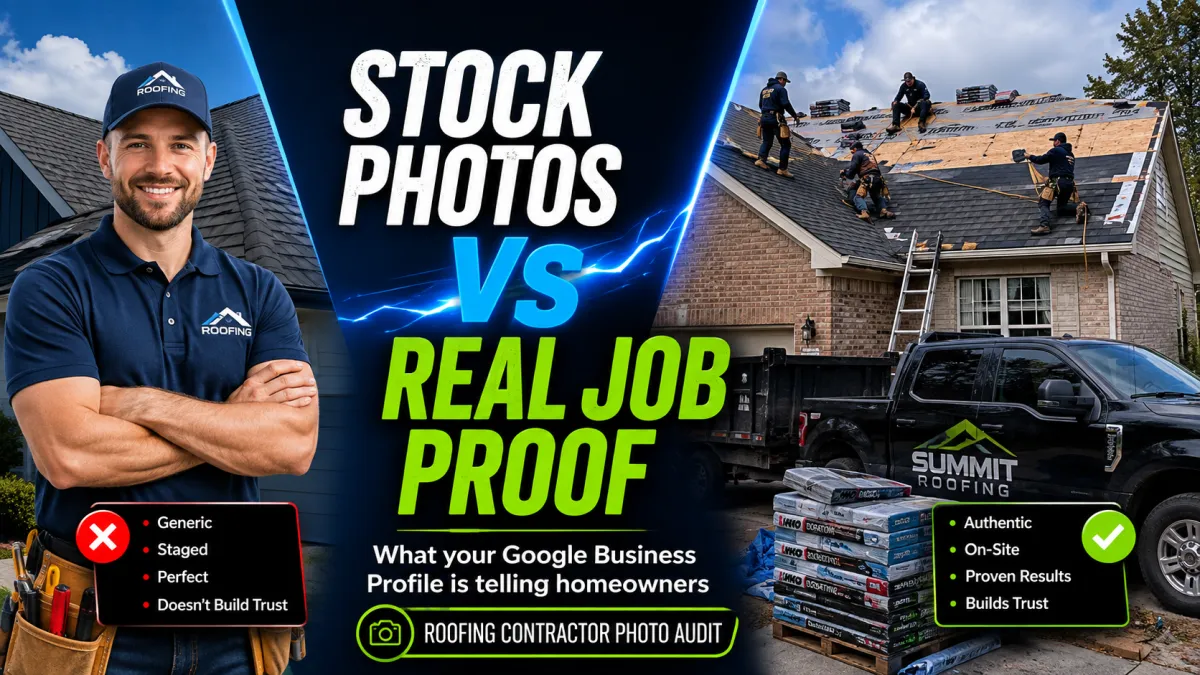
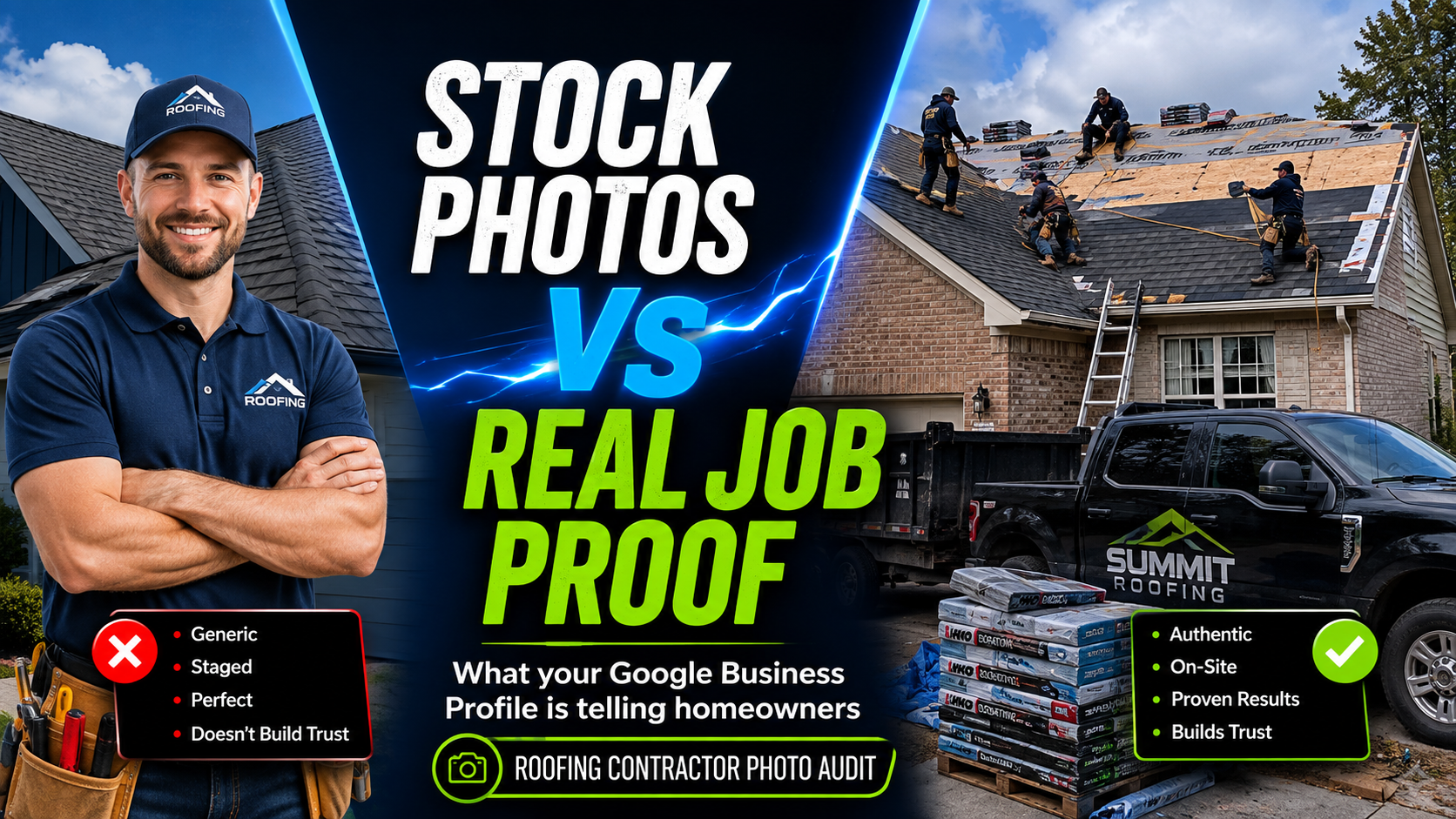
Stock photos are one of the easiest ways to make a real roofing company look less real. A smiling model in a spotless hard hat, a perfect aerial roof shot, a manufacturer-style shingle photo, or a staged roofer pointing at a roof may look polished — but those images prove very little about your company.
Now compare that with a real photo from one of your jobs: your branded truck in the driveway, your crew on the roof, bundles of shingles on-site, underlayment going down, a tear-off in progress, and the actual neighborhood around the home.
The lighting may not be perfect. The picture may have been taken on a phone. That is fine. The homeowner can now see something the stock image cannot prove: your company actually does the work.
For trust, an average real job photo can be more valuable than a perfect stock photo.
Mistake #2: Lots of Photos, Almost No Roofing Proof
A gallery can look full and still contain very little useful evidence. Imagine a profile with 40 photos. At first glance, that sounds strong. But what happens when you break those 40 images down?
·12 logos and promotional graphics
·9 truck photos
·7 team or office photos
·5 manufacturer images
·4 generic roof photos
·3 actual roofing jobs
Technically, the profile has 40 photos. Practically, the homeowner sees only three pieces of direct evidence that the company is actively doing roofing work.
That is why photo count by itself is a weak metric. A better question is your proof density: out of the first 20 meaningful photos a homeowner sees, how many actually demonstrate your work?
·Real roofing projects
·Actual crews
·Tear-offs
·Underlayment or flashing
·Shingle installation
·Storm damage
·Completed roofs
·Before-and-after results
If your first 20 photos are mostly logos, trucks, headshots, office pictures, and graphics, the homeowner still has to imagine whether you are good at the work they need. Do not make them imagine. Show them.
Mistake #3: Your Photos Do Not Match the Jobs You Want
Suppose full roof replacement is one of your most valuable services. Your website talks about replacement. Your Google Business Profile lists roofing services. Your sales team wants more replacement leads.
Then a homeowner opens your photo gallery and sees a truck, a logo, a gutter job, a team photo, another truck, a small repair, and a supplier graphic.
Where are the completed roofs?
If you want more full replacement work, your gallery should contain repeated evidence that you regularly complete full replacements. The same rule applies to every service you want more of.
·Want more storm-damage work? Show storm damage and completed restoration.
·Want more metal roofing? Show metal roofing projects.
·Want more commercial roofing? Show commercial projects.
·Want more flat-roof work? Show flat roofs.
·Want more premium shingle replacements? Show premium shingle replacements.
Your visual evidence should match the services you are trying to sell. A customer should be able to scan your profile and think, “These guys do exactly what I need.”
Mistake #4: You Are Not Using Before-and-After Photos
Roofing is especially well suited for before-and-after proof because the transformation is often obvious. Worn shingles, storm damage, missing shingles, staining, and visible deterioration can be contrasted directly with a clean finished roof.
A finished roof by itself tells the homeowner that you photographed a roof. A before-and-after pair tells them that you transformed one.
Build this into the job process. Capture the condition before work begins. After cleanup, capture the finished result from roughly the same angle whenever possible. Two photos can tell a complete visual story: problem, work, result.
Mistake #5: Your Business Has No Human Proof
Another common gallery is nothing but roofs, trucks, shingles, and equipment. But a homeowner is not only buying materials. They may be putting a crew on their property for an entire day or longer.
Show the people behind the work:
·Your roofing crew
·The estimator or foreman
·Branded clothing
·The truck and trailer
·Someone performing an inspection
·The crew working
·A team member cleaning the property after the job
These do not need to be staged team portraits. Natural work photos can be stronger because they connect the company name with a real operating business. There is a big difference between seeing another picture of shingles and seeing the people responsible for installing them.
Mistake #6: Your Photo Gallery Looks Abandoned
Look at the newest meaningful job photo on your profile. Not the newest logo or promotional graphic — an actual roofing project.
Was it last week? Last month? Six months ago? Fourteen months ago?
A stale gallery can create questions in a homeowner's mind: Is this company still active? Are these photos from years ago? Do they still do this type of project?
Now compare that with a competitor showing recent roof replacements, storm-damage work, crews on-site, material deliveries, and completed homes. That gallery communicates activity.
You do not need to upload dozens of photos every day. You need a repeatable process that keeps your visual evidence current.
The Five-Photo Roofing Job System
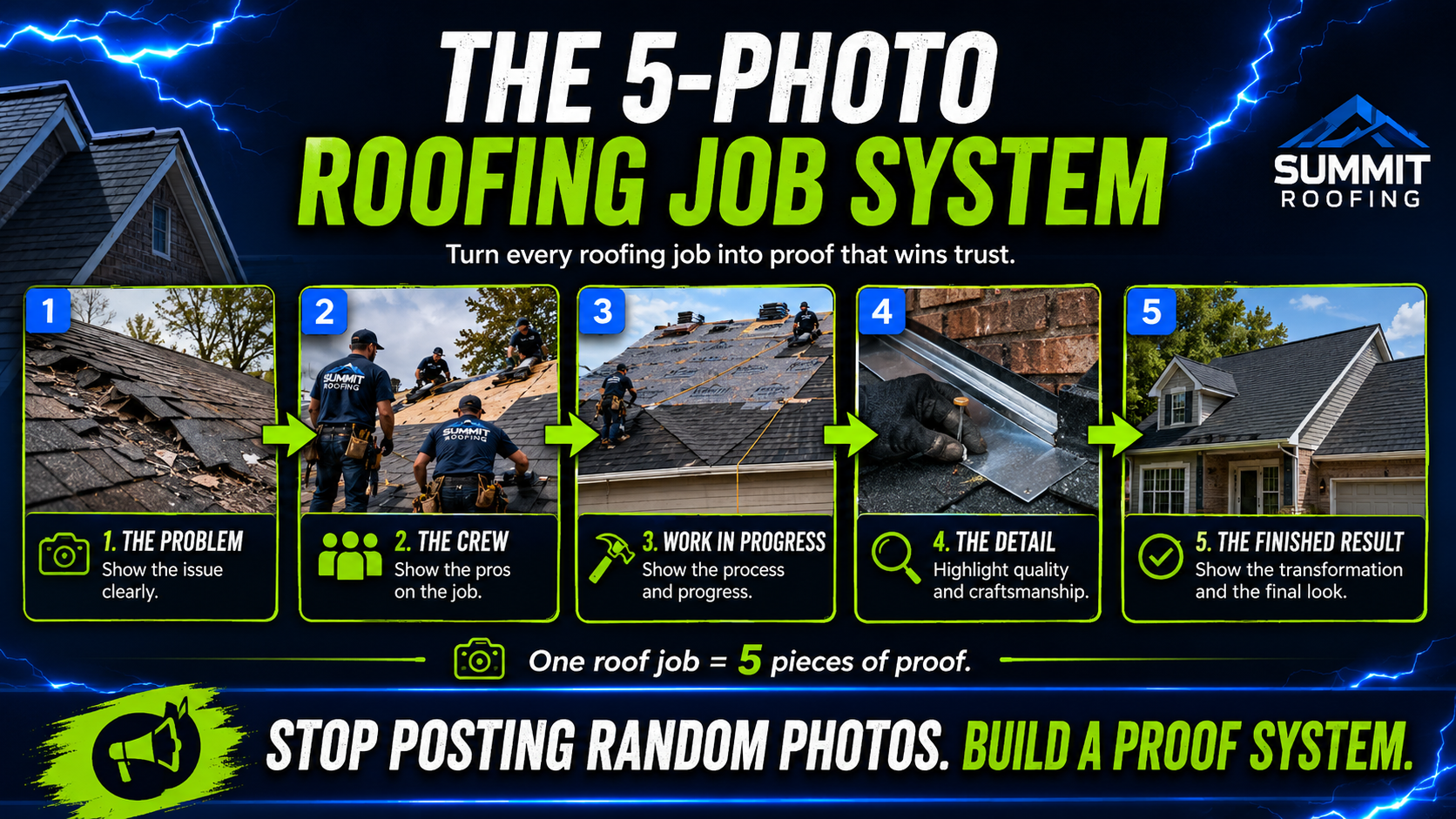
Instead of taking random photos, give your crew or whoever handles job documentation a simple five-photo system. Every worthwhile roofing project can potentially produce these five proof assets:
1. The Problem: Capture what the homeowner hired you to solve: storm damage, missing shingles, aging roof, failed flashing, a leak source, or deteriorated materials.
2. The Crew: Show real people from your company at the property: estimator, foreman, crew, or installer.
3. Work in Progress: Show the job happening: tear-off, decking inspection, underlayment, ice and water shield, flashing, or shingle installation.
4. The Roofing Detail: Capture something that demonstrates the quality or type of work: ventilation, flashing, valley, shingle detail, metal section, or roofing system.
5. The Finished Result: Show the completed roof, clean property, finished lines, and the full home whenever possible.
Now one roof replacement does not create one random picture. It creates an evidence package. If your company is completing projects every week, the content already exists. You just need a system to capture it.
Run a Roofing Competitor Photo Audit
Search Google the way a homeowner would search for one of your valuable services in your market — not your company name. Examples include “roofing contractor near me,” “roof replacement,” “roof repair,” “storm damage roofer,” or a city-based roofing search.
Open the profiles appearing beside or above you and go directly to their photos. For this exercise, you are not trying to diagnose every ranking factor. You are comparing what the homeowner can see.
Take the first 20 meaningful photos from your company and compare them with the first 20 from a competitor. Ask:
·How many show real roofing projects?
·How many show crews?
·How many show completed roofs?
·How many demonstrate the exact service?
·How many are recent?
·How many contain before-and-after evidence?
·How many clearly belong to that contractor?
·How many feel like real work instead of marketing material?
The difference can become obvious quickly. You may have more reviews, more years in business, better materials, or a stronger warranty — while the competitor is doing a much better job visually proving that they are active and experienced.
That is fixable.
The Five-Minute Google Business Profile Photo Audit
Open your Google Business Profile as if you were a homeowner who has never heard of your company. Then ask these seven questions:
1. Can I immediately see real roofing work — not logos or graphics, but actual jobs?
2. Can I identify the roofing services this company performs?
3. Can I see real people from the company?
4. Can I see completed outcomes, not just materials and work in progress?
5. Does the company look active today, or does the gallery feel old?
6. Would these photos make me more comfortable trusting this company with my house?
7. Does my strongest competitor look more credible than I do?
If the answer to the last question is yes, you have identified a problem you can work on.
What Does Your Profile Prove?
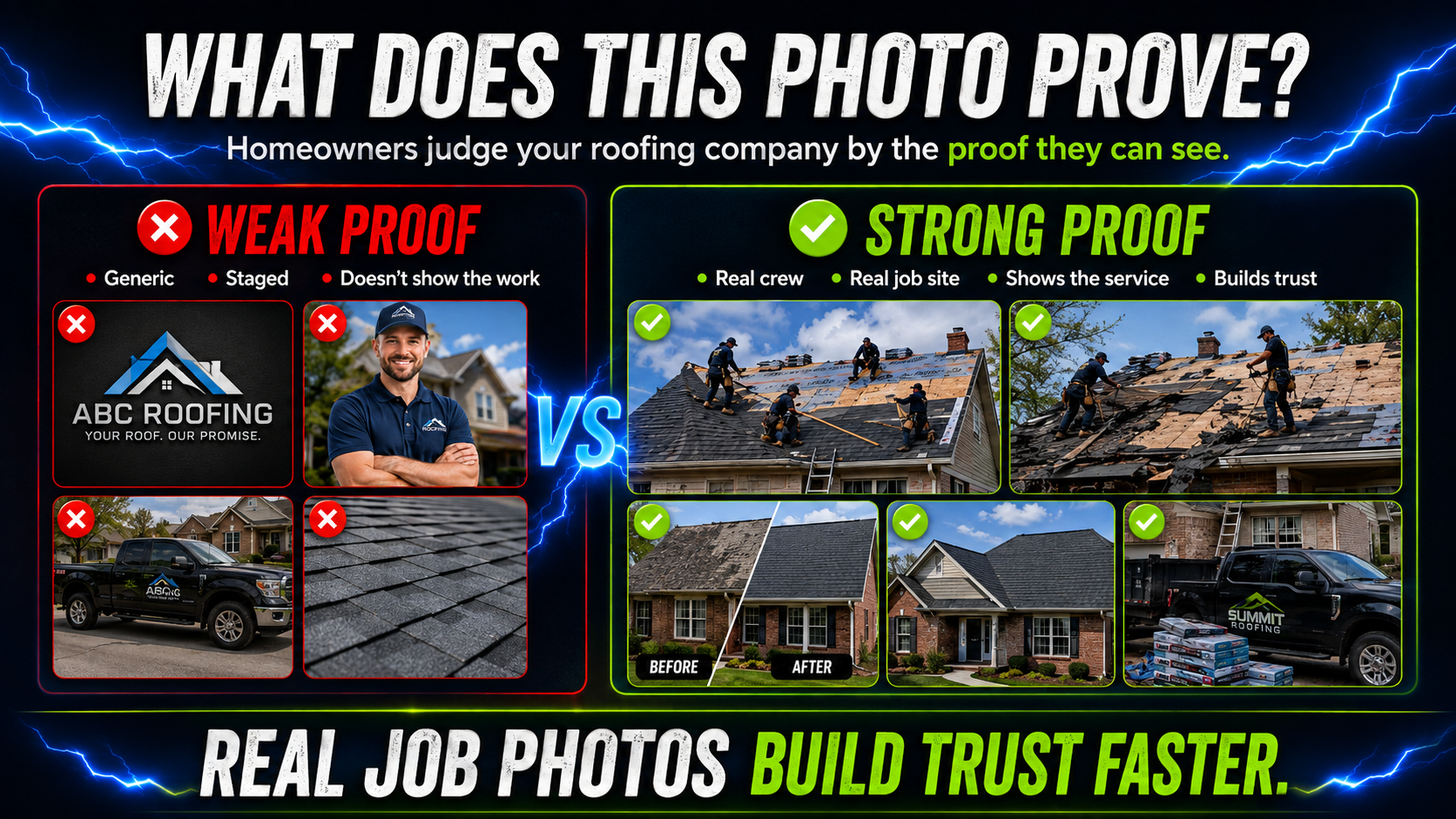
Your Google Business Profile photos should not be a random folder of images somebody remembered to upload. They should be evidence.
·Evidence that your roofing company is real.
·Evidence that you are active.
·Evidence that you perform the service.
·Evidence that your crews do the work.
·Evidence that you complete projects like the one the homeowner needs.
·Evidence that hiring you is a safe decision.
Stop asking whether your photos look good. Start asking: “What does this photo prove?”
Then compare your proof with the roofing company sitting beside you on Google, because the homeowner may be making exactly the same comparison.
Watch the Full Contractor Breakdown
The full YT-007 video walks through each mistake visually, shows the five-photo roofing job system, and demonstrates how to run the competitor audit.
Watch YT-007:
If the video helps, LIKE it, SUBSCRIBE to Revenue Pilot AI, SHARE it with another contractor, and comment PROOF + your trade. Those actions help us build more contractor-focused breakdowns like this.
If you want help identifying Google Business Profile gaps that may be costing your business visibility, calls, and jobs, you can also review Revenue Pilot AI’s GMB Visibility Fix:


