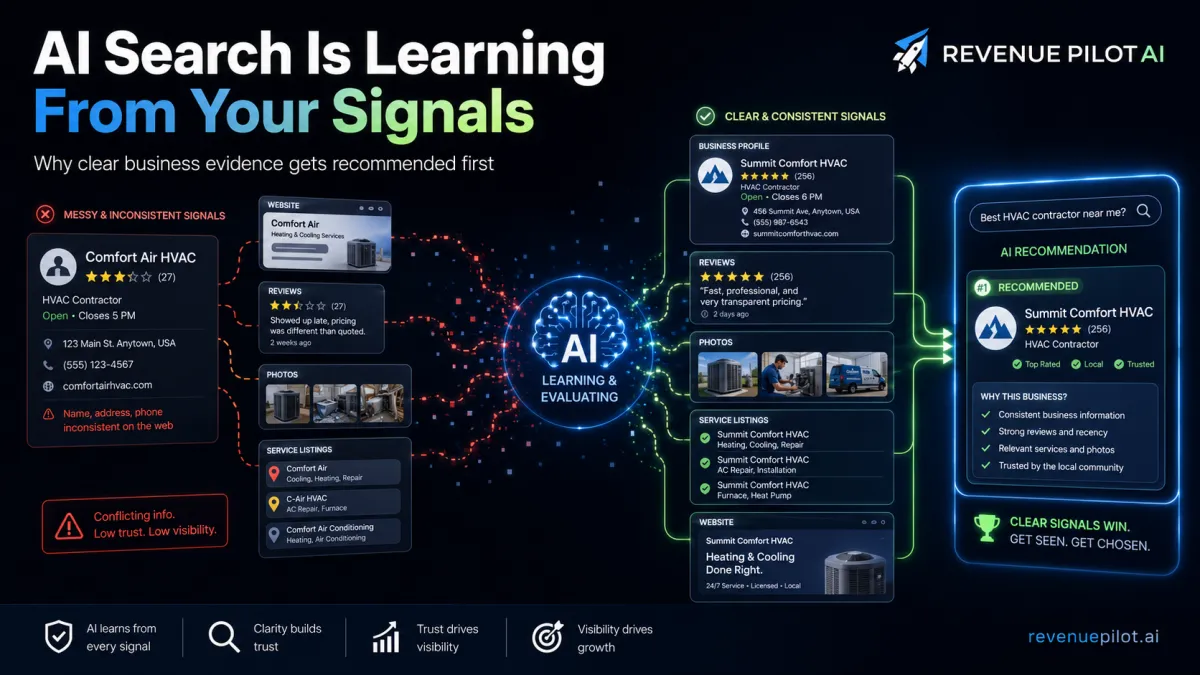
Why AI Recommends Your Competitors Instead of You
How to make your local business easier for AI search engines and recommendation systems to understand, trust, and recommend
Customers are no longer only typing short phrases into a search box. They are asking Google AI, Gemini, ChatGPT, and other AI tools full questions about which local business they should call.
Questions such as “Who offers same-day furnace repair near me?”, “Which contractor works on older homes?”, or “Who offers financing?” require more than a list of nearby companies. They require a recommendation.
That changes the competition. The company with the most reviews, the largest fleet, or the longest history does not automatically win. AI can only recommend the businesses it can clearly understand and explain.
That is why a smaller competitor can sometimes appear ahead of a more established company. The smaller business may simply provide clearer, more specific, and more consistent evidence across the web.
Watch the full video: https://youtu.be/RtdO92y-BX4
1. Your category tells AI what kind of business you are
A broad category such as “contractor” leaves too much room for interpretation. It does not tell AI whether the company specializes in HVAC, roofing, plumbing, electrical work, remodeling, or something else.
A more specific primary category gives AI a stronger starting point. “HVAC contractor” immediately connects the business with heating, cooling, repair, and installation.
The opposite problem also exists. Adding too many unrelated categories can dilute the business identity. A profile that claims to be an HVAC contractor, plumber, handyman, appliance repair company, and general contractor may become harder to classify, not easier.
The goal is not to choose the largest number of categories. The goal is to make the business easy to classify with one clear primary identity and only relevant supporting categories.
2. Specific services help AI match specific questions
A phrase such as “heating and cooling” is too vague to answer many customer questions. It does not confirm whether the company repairs boilers, installs heat pumps, replaces furnaces, services mini-splits, or offers emergency no-heat service.
AI search depends on specific matches. When a customer asks who repairs boilers, the strongest candidate is usually the business that clearly documents boiler repair across multiple sources.
Two companies may perform the exact same service, but the one that proves it through its profile, website, reviews, and photos is easier for AI to understand and recommend.
Service information should agree across the Google Business Profile, website, directories, reviews, and other public sources. Missing or conflicting service information weakens confidence.
3. Generic website copy gives AI very little to work with
A homepage headline such as “Quality service you can trust” may sound professional, but it does not identify the service, location, specialty, availability, process, or buying details.
A specific page about emergency furnace repair in Arnold, Missouri gives AI something useful. It can explain the problem, identify the service area, describe same-day availability, answer common questions, and provide evidence of expertise.
Pricing context, financing information, service areas, emergency availability, warranties, and frequently asked questions all make a website more answerable.
AI cannot confidently recommend a business it cannot clearly explain. Specific service pages make the company easier to match to real customer requests.
4. Reviews teach AI what your business is known for
Reviews provide much more than a star rating. They can identify the service performed, the location served, the speed of the response, the customer problem, and the outcome.
A review that says “Great company” provides almost no context. A review that says “They repaired our furnace in Arnold and restored heat that afternoon” provides the service, location, speed, and result.
Patterns across many reviews can reveal real specialties. Repeated mentions of furnace repair, heat-pump installation, same-day service, or a specific city help AI understand what the company consistently does.
Businesses should ask for honest feedback about the work customers actually received. They should not script reviews or reward positive comments. Authentic detail is more valuable than forced wording.
5. Real photos create stronger business evidence
Polished stock photos may look professional, but they do not prove that a real technician works for the company, serves the local area, or completed a real job.
Authentic photos can confirm a branded vehicle, an active technician, a completed installation, a local team, a shop location, or a before-and-after result.
Clarity matters too. A dark, blurry, or confusing photo is harder for both customers and AI systems to interpret. Real photos should be bright, clear, and focused on the work being documented.
Each photo should prove something: local presence, workforce, service capability, or completed outcome.
6. Social content should document real work
Generic holiday graphics, motivational quotes, random memes, and stock images teach AI very little about the business.
Useful content documents real problems and real services. A furnace repair, heat-pump installation, roof inspection, drain-camera job, or electrical upgrade gives AI concrete information about what the company does.
One real service call can become an Instagram Reel, Facebook post, YouTube Short, Google Business Profile update, and website case study.
The format changes, but the underlying evidence stays consistent. One job can create multiple confirming signals across trusted sources.
7. Consistency helps AI recognize one coherent business
AI has to connect information from many sources. If the business name, phone number, website, category, service area, or service list changes from one platform to another, the business becomes harder to identify.
Consistent core facts help AI recognize one coherent entity. The same name, phone number, website, category, services, and service area should appear wherever the business is represented online.
Consistency does not mean copying the same paragraph everywhere. It means making sure every source tells the same factual story about who the business is, what it does, and where it works.
Why the smaller competitor can win
The larger company may have more reviews, more trucks, and a longer history. But if its categories are broad, its services are incomplete, its website is generic, its photos are mostly stock, and its listings are inconsistent, AI has to fill in too many gaps.
A smaller competitor may provide fewer total signals, but those signals may be more specific and consistent. AI can identify the business type, match the requested service, confirm the service area, and explain why the company fits the customer’s question.
In AI search, clarity can beat size because recommendation systems need evidence they can use.
A practical AI-search optimization checklist
Use one clear primary business category.
List the exact services customers may ask about.
Create specific service pages for important services and locations.
Add useful buying details such as availability, pricing context, financing, and FAQs.
Ask for honest reviews that describe the work customers received.
Publish clear photos of real vehicles, technicians, jobs, equipment, and outcomes.
Repurpose real jobs across social channels, the Business Profile, YouTube, and the website.
Keep the business name, phone, website, categories, services, and service area consistent.
The next step
AI cannot confidently recommend a business it does not understand.
The goal is not to manipulate an algorithm or repeat keywords unnaturally. The goal is to make the truth about the business easier to find, verify, and explain.
A Google Business Profile audit can identify unclear categories, missing services, inconsistent information, weak photos, and other gaps that may also affect how AI systems understand the business.
Get a free Google Business Profile audit: https://morelocalleadsnow.com/gmb-visibility-fix
Watch the complete video: https://youtu.be/RtdO92y-BX4


